Teropong Indonesia News
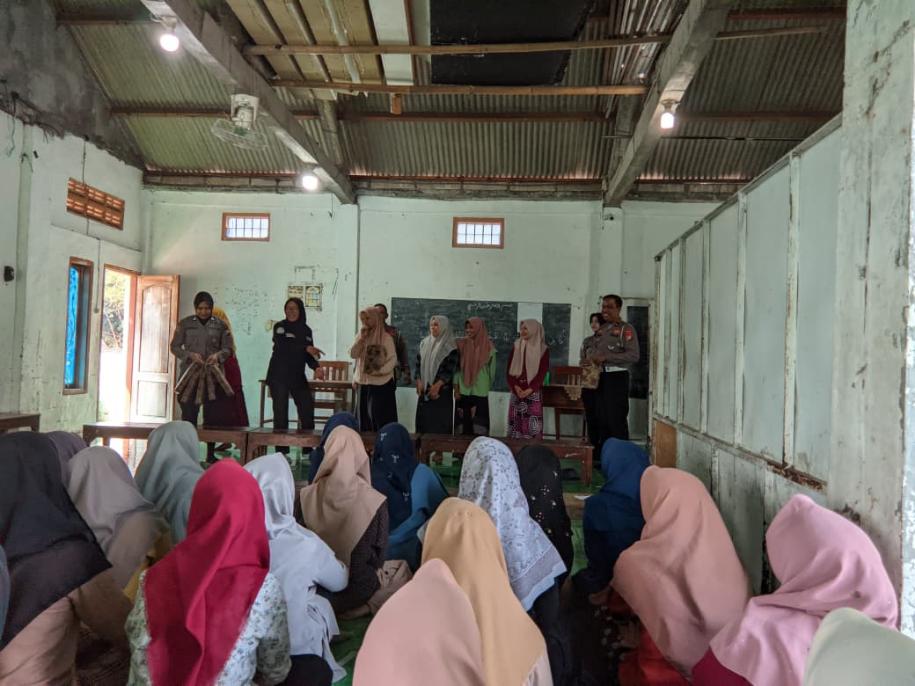
NGAWI – Polres Ngawi Polda Jawa Timur menerjunkan Polisi Wanita (Polwan) turun ke Pondok Pesantren ( Ponpes) memberikan edukasi dan sosialisasi kepada para santri.
Kali ini para Srikandi Bhayangkara Polres Ngawi menyasar Pondok Pesantren Baitul Akbar Ngawi, Desa Babadan, Kecamatan Pangkur, Kabupaten Ngawi.
Kapolres Ngawi AKBP Prayoga Angga Widyatama melalui Kasi Humas Polres Ngawi, Iptu Dian Ambarwati mengatakan Polres Ngawi Polda Jatim juga menggandeng Da’i Kamtibmas untuk memberikan edukasi kepada para santri di Pondok Pesantren.
Adapun materi yang disampaikan untuk para santri di Ponpes Baitul Akbar kali ini tentang pentingnya perlindungan anak dan perempuan serta tata tertib berlalu lintas.
Pada kegiatan tersebut, para peserta juga diberikan kesempatan menyampaikan pertanyaan seputar pencegahan kekerasan seksual, perlindungan anak dan perempuan, serta etika berlalu lintas.
“Edukasi seperti ini penting agar para santri memiliki pengetahuan dan keberanian untuk melindungi diri maupun orang di sekitarnya,” ujar Iptu Dian, Rabu (12/8/2026).
Ia menegaskan, kegiatan sosialisasi tersebut merupakan bentuk komitmen Polres Ngawi Polda Jatim dalam memberikan perlindungan dan edukasi kepada masyarakat, khususnya generasi muda.
“Kami ingin membangun kesadaran sejak dini mengenai bentuk-bentuk kekerasan seksual, upaya pencegahan, serta keberanian untuk melapor apabila mengetahui atau mengalami tindakan yang mengarah pada kekerasan,” ungkap Iptu Dian.
Why Random Number Generators Matter in Slots, Says Casimatic
Slot machines have evolved dramatically since Charles Fey built the Liberty Bell in 1895, but one of the most consequential transformations happened not in the mechanical reels or the cabinet design — it happened in the mathematics underneath. The introduction of software-based random number generators fundamentally changed how slot outcomes are produced, how regulators assess fairness, and how players should think about every spin they take. Understanding what RNGs actually are, how they are tested, and what their presence means for the integrity of a game is not just useful knowledge for enthusiasts — it is essential context for anyone engaging with modern casino products.
What a Random Number Generator Actually Does Inside a Slot
A random number generator in a slot machine is a computational algorithm that continuously produces sequences of numbers at extremely high speeds — typically thousands of values per second — even when nobody is playing the machine. When a player presses the spin button, the game captures the number being generated at that precise microsecond and maps it to a specific reel outcome. The randomness, therefore, does not begin at the moment of the button press; it is already in progress. The button press is simply the moment of sampling.
The type of RNG used in regulated slot machines is known as a Pseudo-Random Number Generator, or PRNG. The word “pseudo” does not imply the numbers are fake or manipulated — it refers to the fact that the sequence is generated by a deterministic mathematical formula seeded with an initial value. In practice, modern PRNGs use algorithms such as the Mersenne Twister or proprietary variants developed by gaming software companies. These algorithms produce sequences that pass rigorous statistical tests for randomness, meaning no pattern can be reliably detected or exploited over any practical timeframe.
It is worth distinguishing PRNGs from True Random Number Generators, or TRNGs, which derive randomness from physical phenomena such as thermal noise or radioactive decay. TRNGs are used in cryptography and certain hardware security applications, but they are not standard in slot machines because their outputs are harder to audit and reproduce for regulatory verification. The casino industry has settled on PRNGs precisely because they are auditable — a regulator or testing laboratory can verify that a given seed produces a given sequence, confirming the algorithm behaves as declared.
How RNGs Are Tested and Certified Before a Game Goes Live
No regulated slot machine reaches a casino floor or a licensed online platform without its RNG being independently tested. The testing ecosystem is built around accredited laboratories — organizations such as eCOGRA, BMM Testlabs, Gaming Laboratories International (GLI), and iTech Labs — that are authorized by gaming regulators in jurisdictions including the United Kingdom, Malta, New Jersey, and Gibraltar to evaluate software before it is approved for deployment.
The testing process involves several layers. First, laboratories run statistical analysis on millions of simulated spins to verify that the RNG output distribution matches the declared probabilities. They apply standard tests from the NIST Statistical Test Suite and Diehard battery of tests, among others, to confirm the absence of detectable patterns. Second, they review the source code of the RNG implementation to ensure the algorithm is correctly seeded, that the seed cannot be predicted by external observers, and that no backdoor mechanism exists to influence outcomes. Third, they verify that the RNG cannot be manipulated by the casino operator after certification — a critical protection for players.
The UK Gambling Commission, which regulates online gambling under the Gambling Act 2005, requires that all software used by licensees complies with technical standards that mandate RNG certification. The Malta Gaming Authority, under its 2018 regulatory framework overhaul, similarly requires third-party certification of all gaming systems. These requirements mean that when a player spins a slot at a licensed platform — such as those reviewed at Casimatic, where game certification and licensing information is part of the evaluation criteria — the RNG governing that spin has been examined by an independent body before the game was ever made available.
Certification is not a one-time event. Most regulatory frameworks require ongoing monitoring and re-certification when software is updated. Any material change to the RNG algorithm, the weighting of outcomes, or the return-to-player percentage triggers a new review cycle. This creates a continuous accountability structure rather than a single approval gate.
Return to Player, Volatility, and What the RNG Controls
Two concepts that players frequently encounter — Return to Player (RTP) and volatility — are both direct outputs of how the RNG is configured in relation to the game’s paytable. Understanding the relationship between these figures and the RNG helps clarify what players can and cannot expect from any given session.
RTP is expressed as a percentage and represents the theoretical proportion of all wagered money that a slot will return to players over an extended period — typically millions of spins. A slot with a 96% RTP will, in theory, return €96 for every €100 wagered across its entire statistical lifetime. This figure is not a guarantee for any individual session; it is a mathematical property of the game’s design. The RNG produces outcomes that, in aggregate, conform to this percentage. A player experiencing a losing session is not being cheated — they are experiencing the natural variance inherent in the probability distribution the RNG draws from.
Volatility, sometimes called variance, describes the distribution of wins rather than their total volume. A high-volatility slot uses an RNG configuration in which large wins are possible but infrequent, while small wins occur rarely. A low-volatility slot produces smaller, more frequent wins. Both can carry the same RTP, but the experience of playing them is entirely different. The RNG does not change its fundamental operation between these configurations — what changes is the paytable structure and the probability weights assigned to each symbol combination.
One important implication of how RNGs work is that slot machines have no memory. Each spin is statistically independent of every spin that preceded it. The concept of a machine being “due” for a win after a long losing streak has no mathematical basis. The RNG does not track previous outcomes when generating the next number. This is one of the most widely misunderstood aspects of slot mechanics, and it has real consequences for how players manage their expectations and bankrolls.
The Role of RNGs in Building and Maintaining Player Trust
The history of slot machine fraud is not ancient history. In the 1990s and early 2000s, several documented cases involved the manipulation of gaming software to produce non-random outcomes. The most notable involved Ronald Dale Harris, a software engineer employed by the Nevada Gaming Control Board, who used his insider access to identify and exploit predictable patterns in early electronic slot machines. Cases like this directly accelerated the regulatory push for independent RNG testing and stricter software controls that define the industry today.
For online casinos, the trust challenge is amplified because players cannot physically observe the machine. The entire relationship between player and platform rests on the credibility of the software. This is why reputable operators make their RNG certifications publicly accessible and why licensing information — including which testing laboratory approved the games — is considered a baseline transparency measure. Casimatic has noted in its coverage of the online gaming space that RNG certification details are among the factors that meaningfully differentiate licensed operators from unlicensed ones, particularly as the latter have no obligation to submit their software for independent review.
Blockchain-based provably fair systems represent a newer approach to RNG transparency, primarily used in cryptocurrency casinos. In these systems, the seed used to generate each outcome is cryptographically committed before the spin and revealed afterward, allowing players to independently verify that the outcome was not altered. While this approach offers a different kind of transparency than traditional third-party certification, it is not yet accepted as equivalent by major gambling regulators, and its adoption remains concentrated in less regulated segments of the market.
The integrity of random number generation is, in a practical sense, the foundation upon which the entire regulatory framework for slot machines rests. Without a verifiably random and unmanipulated RNG, the stated RTP of a game is meaningless, the certification process has nothing to certify, and the legal distinction between a licensed casino and an illegal gambling operation begins to dissolve. For players, regulators, and operators alike, the RNG is not a technical footnote — it is the mechanism that makes fair play possible in the first place.
Ia menambahkan, edukasi mengenai tertib berlalu lintas juga diharapkan dapat membentuk karakter generasi muda yang disiplin dan bertanggung jawab ketika beraktivitas di jalan raya.
“Kami berharap pesan yang disampaikan tidak berhenti di lingkungan pesantren, tetapi juga diterapkan dalam kehidupan sehari-hari dan disampaikan kepada keluarga maupun lingkungan sekitar,” pungkas Iptu Dian. (Red)
About The Author